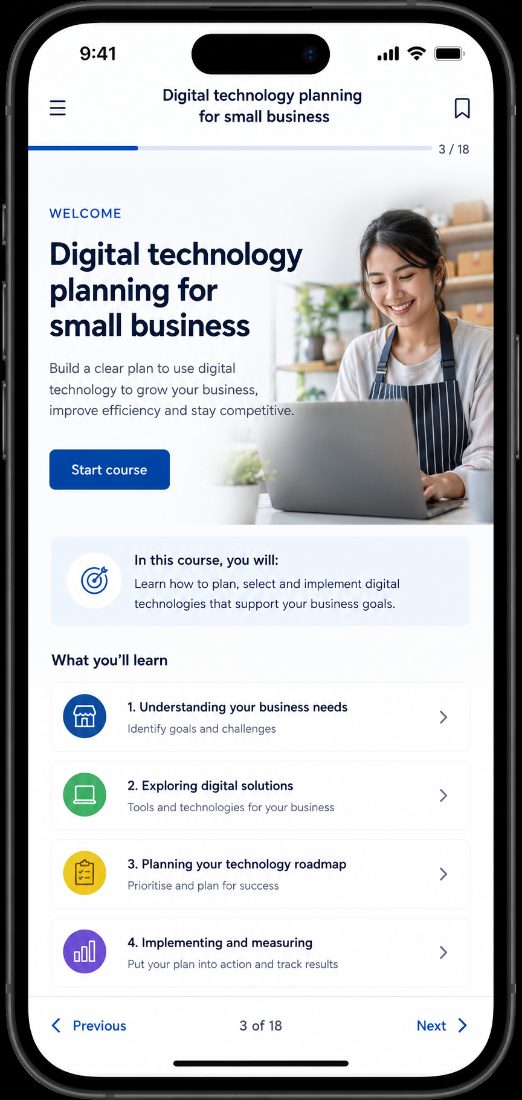
Learning experience design treats a course the way a product team treats an app: something people must want to use, not just be assigned. These seven habits consistently lift the quality of what we ship.
1. Know your audience before you write a word
A course for apprentices on worksites is not a course for graduate accountants. Understand who your learners are, what they already know, and where they will be when they study — everything else follows from that.
2. Set course goals you can measure
"Understand safety obligations" is a wish. "Identify the three highest risks on a site walk-through" is a goal you can design and assess against. Write the goals first and let them discipline the content.
3. Wireframe before you build
Sketch the course structure and key screens before opening the authoring tool. It is far cheaper to move a module on a whiteboard than to rebuild it after review, and stakeholders give better feedback on a skeleton than a polished draft.
4. Design for doing, not reading
Every screen should earn its place by asking the learner to decide, attempt or practise something. If a page only presents text, ask whether it belongs in the course or in a reference document.
5. Make it responsive from the start
Design mobile-first and the desktop version takes care of itself. Retrofitting responsiveness after sign-off is where budgets go to die.
6. Build accessibility in, not on
Captions, contrast, keyboard navigation and plain language planned from the storyboard cost little and help every learner. Bolted on at the end, they cost a remediation project.
7. Test early, iterate often
Put a rough version in front of real learners before the build is finished, watch where they hesitate, and adjust. An agile loop of small releases and honest feedback beats a big-bang launch every time.